

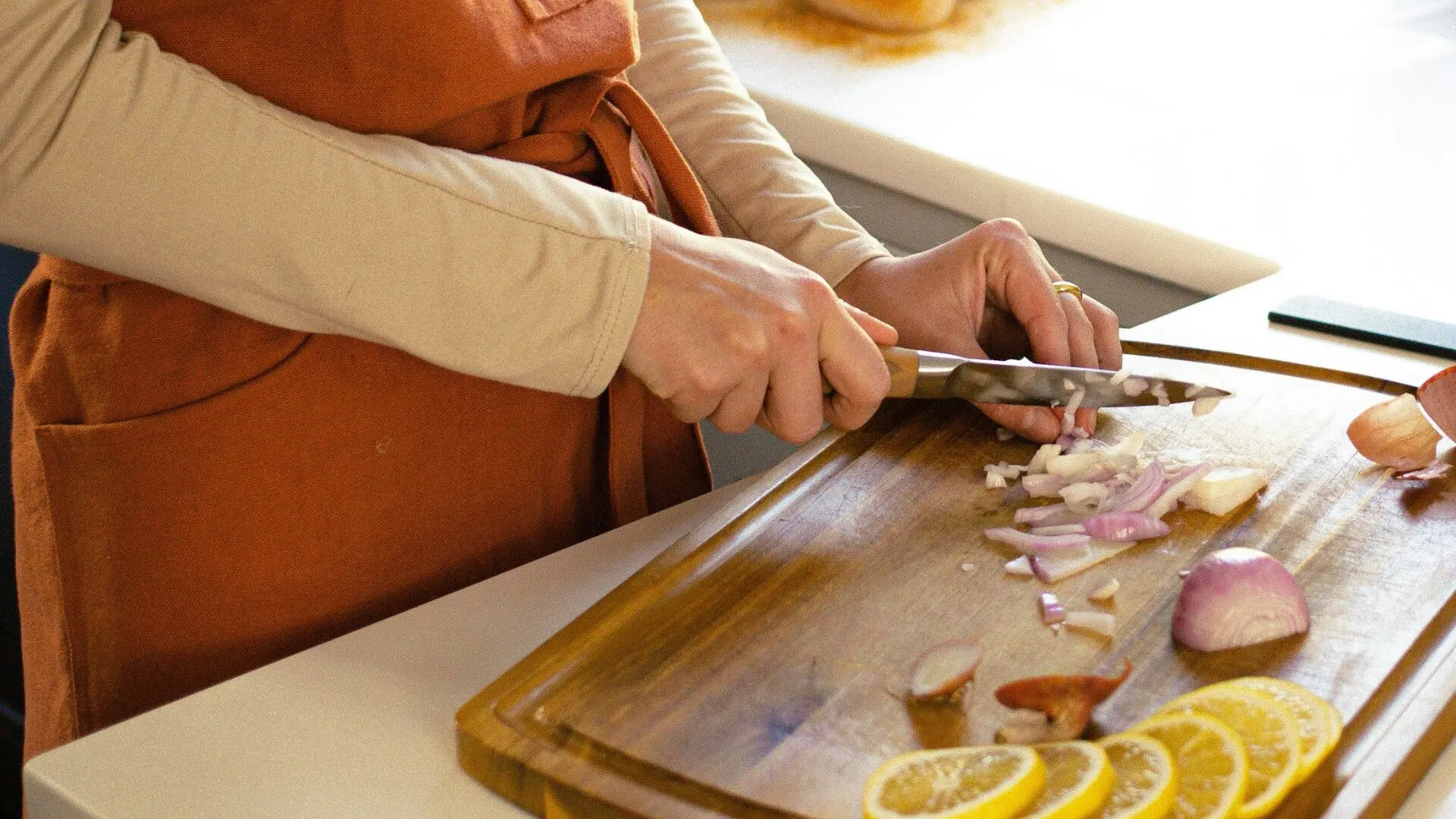
You know those kitchen hacks that promise to change your life? The ones where someone swears you can pit 30 cherries in 10 seconds using a bottle and a chopstick, or that rubbing your onions with lemon will stop you from crying? Some of them work. Most of them are nonsense that’ll leave you with cherry juice on your ceiling and still crying over your onions.
Here’s what food science actually says about the hacks cluttering your social feeds.
The ones that actually work
Adding salt to pasta water makes it boil faster
False, but it does something better. Salt actually raises water’s boiling point slightly through a process called boiling point elevation, which means it takes marginally longer to boil. Harold McGee notes in On Food and Cooking that it takes one ounce of salt per quart of water to raise the boiling point just 1°F. What salt really does is season your pasta from the inside out as the starch granules absorb salted water while they hydrate. You need more salt than you think, roughly the salinity of seawater.
Room temperature eggs are better for baking
True, and there’s actual chemistry behind it. Cold eggs don’t emulsify as well with butter and sugar, which can lead to curdled-looking batter. When eggs are at room temperature (around 70°F), their proteins are more flexible and create more stable emulsions with fats. This means better texture in cakes and more volume in meringues. Multiple baking experts confirm that room temperature eggs whip up to eight times their volume, while cold eggs struggle to incorporate air efficiently. If you forgot to take them out, put them in warm water for 5-10 minutes.
Putting bread in a container with cookies keeps them soft
True, because moisture migrates. When you store baked goods together, water molecules move from areas of high moisture concentration (the bread) to areas of low moisture (the cookies). Sugar is hygroscopic, meaning it attracts and holds water from its surroundings. When bread is sealed in a container with cookies, the sugar in the cookies pulls moisture from the bread, keeping the cookies soft while the bread goes stale. The bread sacrifices itself for the greater good.
Putting a wooden spoon across a boiling pot stops it from boiling over
Surprisingly, yes, but only temporarily. Physics professors explain that the spoon works through a combination of effects: it’s cooler than the boiling water, so steam condenses on contact; it’s porous, so bubbles burst when they touch the rough surface; and it disrupts surface tension. When starchy foam from pasta or rice hits the wooden spoon, the bubbles pop before they can overflow. But this only buys you 30-60 seconds. Once the spoon heats up and gets wet, it stops working. Physics can only save you for so long.
Rinsing rice makes it fluffier
Yes and no. Research has found that washing rice doesn’t significantly affect stickiness or texture. Instead, the variety of rice matters more than whether you wash it. That said, rinsing does remove surface starch (amylose) left over from milling, which can help prevent gumminess in some varieties. For fluffy rice dishes like fried rice or pilaf, rinsing helps. For risotto or rice pudding where you want creamy stickiness, skip it.
The ones that are basically lies
Searing meat seals in the juices
This one has been definitively debunked by food scientist Harold McGee, who calls it “the biggest myth in cooking” that he’s been “trying to debunk for decades.” The myth traces back to 1847 German chemist Justus von Liebig, but it’s been proven wrong repeatedly. Meat is about 70% water locked in muscle fibers. When you sear meat, you’re triggering the Maillard reaction, which creates complex flavors and that brown crust. But sealed? No. As McGee writes in On Food and Cooking, “The crust that forms around the surface of the meat is not waterproof.” Experiments by Alton Brown and J. Kenji López-Alt found that seared meat actually loses more moisture than unseared meat cooked to the same temperature. Sear your meat because it tastes better, not because of magical juice retention.
Adding oil to pasta water prevents sticking
Nope. Oil floats on water due to density differences, so it never comes in contact with the pasta while it’s cooking. What it does do is coat your drained pasta, which then prevents sauce from adhering properly. Food scientists have tested this extensively and confirmed what Italian grandmothers have known forever: just stir your pasta occasionally and use enough water.
Putting avocado pits in guacamole keeps it from browning
This persists because people see the green area directly under the pit and assume causation. What’s actually happening is that the pit is physically blocking oxygen from reaching that specific spot. Enzymatic browning requires oxygen. The pit doesn’t emit some magical anti-browning force field. The guacamole around the edges still browns at the normal rate. Plastic wrap pressed directly onto the surface works infinitely better because it blocks oxygen from the entire surface area.
Rubbing lemon on your knife prevents onion tears
Nice try, but no. When you cut an onion, you rupture cells that release enzymes, which convert sulfur compounds into syn-propanethial-S-oxide, a volatile gas that irritates your eyes. Lemon juice on your knife does absolutely nothing to stop this chemical process. What does work: refrigerating onions before cutting (slows the enzyme), using a sharp knife (ruptures fewer cells), cutting near running water or a fan (disperses the gas), or just accepting that crying is part of the deal.
Microwaving citrus fruits makes them juicier
Sort of true, but mostly unnecessary. Heating citrus does break down cell walls and makes the fruit more pliable, but the same effect happens by rolling the fruit firmly on your counter. The microwave risks overheating the fruit and cooking the juice, which can make it bitter. Room temperature fruit rolled on the counter extracts about 20-30% more juice than cold fruit straight from the fridge, and you don’t have to wait for a hot lemon to cool down.
The Verdict
Most kitchen hacks fall into one of three categories: legitimately useful science, things that work but not for the reasons claimed, or complete fabrications that someone posted once and 47,000 people shared without testing. The ones that actually work tend to be based on pretty straightforward physics or chemistry.
Before you try the next miracle hack that promises to revolutionize your Tuesday night dinner prep, ask yourself if it makes scientific sense. Does it address the actual problem (like oxygen causing browning), or is it just elaborate theater? Your kitchen doesn’t need more theater. It needs you to properly salt your pasta water and use a sharp knife.