
Jen Arsenault’s mornings looked the same for most of her childhood: leftover rice, a bowl of soup, and whatever banchan her mom—her Umma—had made that week. It wasn’t fancy. It was just food. But when Arsenault left for college and found herself without a rice cooker, staring down dining hall trays, she realized how much that everyday spread had actually meant to her. Every visit home, she made a beeline for her mom’s doenjang-jjigae before she’d even put her bags down.
That homesickness eventually turned into Potluck, the line of all-natural Korean pantry staples Arsenault founded after watching other cuisines get the modern, minimal-ingredient treatment while Korean food stayed boxed in as either kimchi or barbecue. She spent time with farms and makers across Korea who still ferment in onggi, ceramic pots buried in the ground, using no preservatives or added sugar—traditional methods she wanted to help protect and share more widely. Potluck is now in roughly 200 stores and has moved into food service, showing up in sandwich shops and restaurants around the country.
These days, Arsenault is applying that same instinct for what’s actually useful to her own kitchen, as a mom. Her son is eight months old, newly crawling, and already moving faster than she can keep up with. The more ambitious cooking projects she used to enjoy have given way to one-pot meals and a heavy reliance on banchan—the side dishes that, once prepped, turn dinner into more of an assembly job than a production. Some nights that’s a real, cooked meal. Other nights it’s rice, whatever banchan is in the fridge, and calling it done.
Below, Arsenault talks about growing up as one of the only Korean kids in her town, why she thinks people sell Korean food short, and shares three banchan recipes worth keeping in rotation—especially on the nights when cooking a full meal just isn’t happening.
Tell me about your relationship with Korean food growing up—what did mealtimes look like in your house?
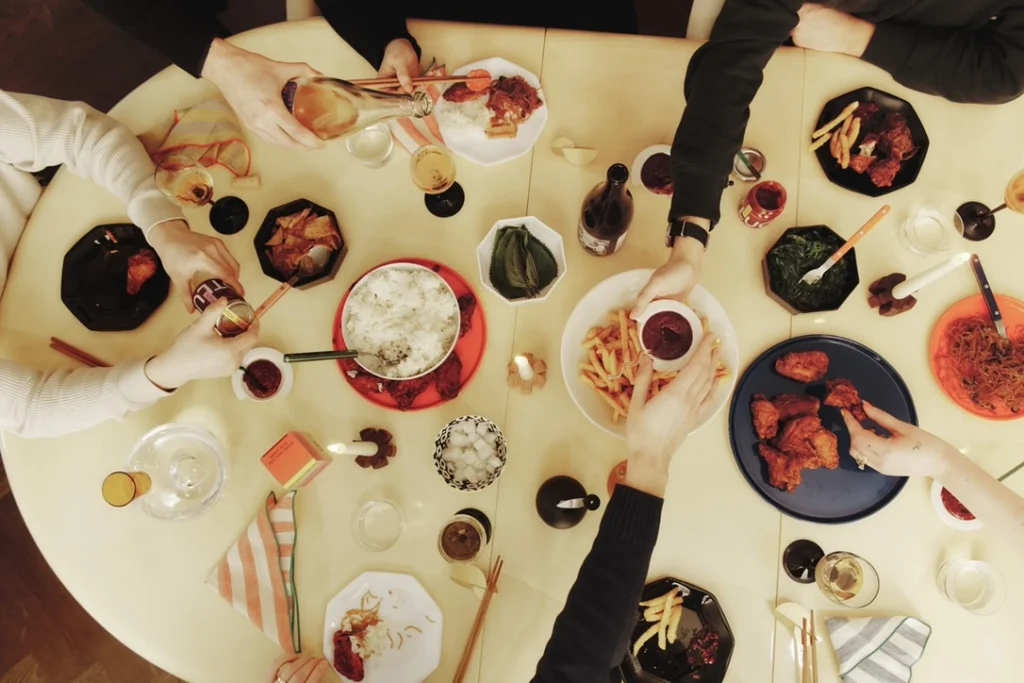
Korean food was just food! I grew up eating a lot of leftover rice and soup for breakfast with some assortment of banchan, side dishes, that my mom (my Umma) made. My dad passed away when I was fairly young so our mealtimes were typically Umma and me and a lot of Korean food. We’d occasionally venture into unknown territory like lasagna or order Korean fried chicken as a treat, but homemade Korean food was the standard and a staple. I probably didn’t appreciate it enough at the time, but Korean food is now known to be one of the most nutritionally complete diets, and as a newer mom myself, I’m more grateful that I had access to delicious, healthy food growing up.
My relationship with Korean food was always comfortable, but I think it raised eyebrows for other kids. I look almost identical to my dad, meaning I look predominately white, and my mom would often pack rice and seaweed for my school lunches. I had the classic second-gen experience of being made fun of, with kids calling the seaweed “black paper.” “It tastes good!” I told them. It still does.
How did you end up starting Potluck? Walk me through that journey from idea to actual jars on shelves.
College was the first time I didn’t have easy access to Korean food. I felt pretty lost without a rice cooker, and the dining hall left much to be desired. Any time I’d come home, the first thing I’d ask for was sundubu, soft tofu soup, or my mom’s doenjang-jjigae, soybean tofu soup. Like I’m sure many do, I always thought my mom’s cooking was the best. Some of her secrets were in the ingredients. Korean cooking is simple, but the ingredients make all the difference. My mom’s family in Korea would mail jangs, sauces or pastes, that they made themselves. Moms at church would trade different types of kimchi. It was all very communal.
It wasn’t until I was out of school and working that I started seeing food brands pop up in other cuisines: Fly by Jing for Sichuan flavors, Diaspora Co. for Indian spices, and I began to wonder why we didn’t have a fun, modern brand around Korean staples. I was too scared at the time to start one myself, so I tried pitching existing Korean food companies that I thought could modernize or use a younger person’s perspective. No one would give me the job I wanted, or even email me back, so after a few years of sitting on the idea, I figured if not them, why not me?
I really wanted people to have access to and experience the highest quality Korean flavors. I talked to farms and makers in Korea utilizing traditional methods—onggi, ceramic pots in the ground for fermentation, cheese cloths, the whole deal—with no preservatives or added sugar. These practices are handed down from generation to generation, and they’re being pushed out by larger factories and corporations that use artificial ingredients. Once I learned more about their businesses, I felt more motivated to support these makers to keep their practices alive, and I’m grateful they took a chance on me. We’re still early, we’re still growing, but we’ve made it to about 200 stores across the country, and we also do food service now, partnering with sandwich shops and restaurants, which has been really fun for me.
What do you think people get wrong about Korean cooking or Korean pantry staples?
I think people box Korean food in too much. If there’s any familiarity with Korean food, it’s often kimchi or Korean BBQ. Korean food is really quite expansive. It’s noodles and seafood and soups and side dishes and meat and vegetables and baked goods and fried foods. When cooking traditional Korean food, most of the work is typically in the prep. The actual cooking is often pretty quick and simple.
The fun part of starting a pantry staples business is seeing how people use our products in both traditional and novel ways. I’ve had other Koreans tell me how exciting it is to see someone make jang cool. This week, a pasta creator tagged us using our gochujang in gnocchi. I love seeing that.
You just had a baby—how’s that been? What’s surprised you most about early motherhood?
He’s already eight months old! He started crawling last week. It’s all going way too fast. That’s probably what’s been most surprising to me, how fast it all is. Those first few months are so all-encompassing. It feels like all of it—the diaper changes, the feedings, the naps—will never end, and now he’s sleeping twelve hours a night and chasing our cat around our apartment.
Has becoming a parent changed how you think about food at all—either cooking it, eating it, or sharing it?
I definitely have a renewed appreciation for easy meals. Before becoming a mom, and especially during Covid, I had an appetite to try making more complicated dishes. Maybe I’m open to that once in a blue moon now, but ease is king and one-pot meals are the new normal. I’m getting a lot of use out of my Staub lately.
What does your actual weeknight dinner situation look like right now?
I usually cook a big meal two to three nights a week. I always make more than we need, so we have leftovers for lunch later in the week. The other nights, my husband does what we call “preparing food,” which looks less like cooking and more like piecing together meals from foods that are either easy to make or we already have prepared, like rice bowls, rice and banchan, or on a lazier night, Annie’s white cheddar mac and cheese.
When you think about the food culture you grew up in versus the one you’re creating now, what feels the same and what’s different?
Korean food culture has existed long before me, and at home, it always felt like this safe, comforting space to explore my heritage. Externally, it felt less understood. I was born in Massachusetts and lived there until I was seven. At the time, there was very little in terms of Korean food culture that was accessible, hence my “black paper” experience.
Later, my mom and I moved to Fort Lee, New Jersey. Outside of LA, Bergen County, where Fort Lee sits, has the highest Korean population in the country, so there, I felt much more myself. I could speak Korean or English in my public school. There were many Korean grocery stores and restaurants we could frequent. But outside of that bubble, the lack of understanding, and some fear about my food preferences being inconvenient or somehow out of the norm, crept back in.
Now, with the prevalence of K-beauty, Korean dramas, and K-pop, there’s a new interest in Korean food that didn’t exist when I was growing up. Consumers are more demanding than they’ve ever been: they want quality, competitive price points, and branding they can identify with. Overall, I think it’s great, this openness to trying new cuisines and interest in understanding different cultures, especially one that goes back thousands of years.
I’ve returned to Massachusetts, to Boston, and now we have any number of Korean grocery stores I can drive to. I can walk to a Korean restaurant or to pick up my Korean fried chicken. It’s quite different from when I was a kid, and I’m grateful for that.
Why banchan? What makes these side dishes such an important part of how you eat?
Banchan adds so much color to a meal. It often utilizes vegetables, so it tends to be healthy. You can mix and match with rice or on top of noodles. It makes cooking easier because instead of having to make a whole meal, you already have at least two-thirds of it prepared. With a few staples, you can skip cooking and move into “preparing” food, or just snack on different banchan and have your own version of a girl dinner.
What are the dishes or flavors you keep coming back to, no matter what phase of life you’re in?
I think we all crave what tastes like home to us. For me, that’s rice and mackerel, a fish my mom grew up eating quite a bit, ssam (grilled meat wrapped in rice, ssamjang, and lettuce), any variety of Korean stews both spicy and mild, jajang-myeon (Korean black bean noodles), and Korean fried chicken.
What do you want people to understand about Korean food—especially people who might be intimidated by it or think it’s too complicated to make at home?
It’s intimidating if you’re looking at a full spread of Korean food and wondering where to begin. It becomes much less scary once you realize a few easy dishes make your life a lot easier. It’s also one of the easiest ways to get your veggie consumption up—for you and your kids—without even realizing it.
3 Banchan Recipes from Jen Arsenault
Arsenault’s go-to banchan, straight from her own kitchen. Serve any (or all) alongside a bowl of rice.
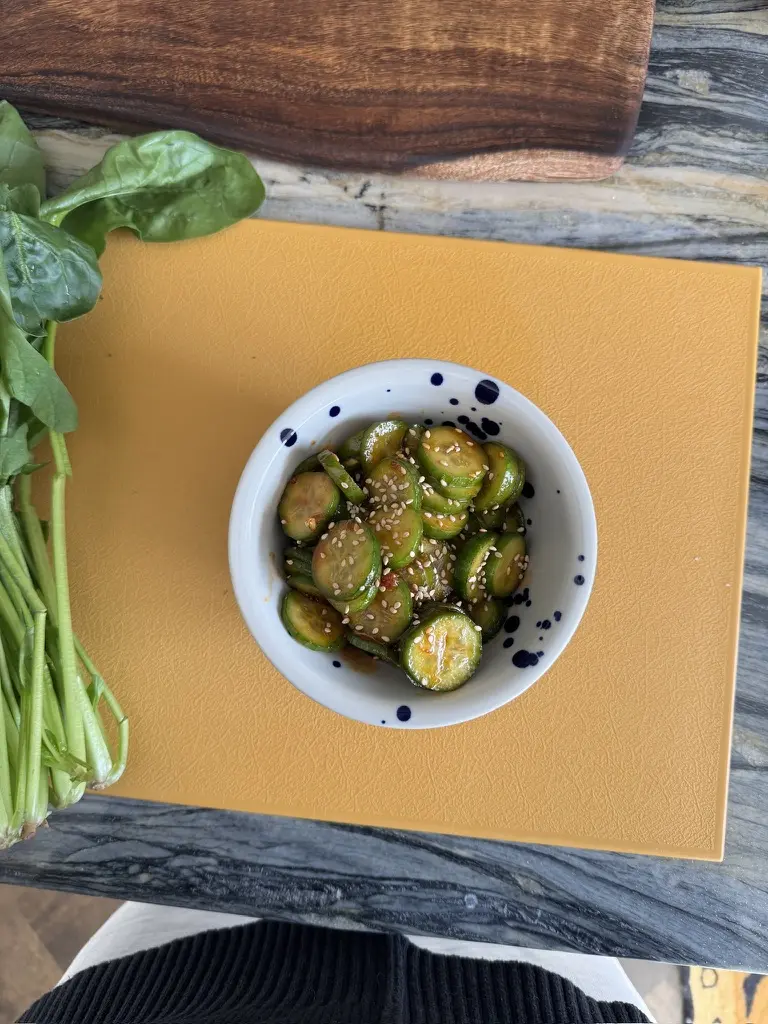
Oi-Muchim (Spicy Cucumber Salad)
Ingredients
- 1 pack mini cucumbers (about 5–6)
- Salt
- 4 cloves garlic
- Gochujang
- Sugar
- Sesame oil
- Sesame seeds (optional)
Directions
Salt the cut cucumbers for about 20 minutes, then rinse with cold water.
Mix in the rest of the sauce ingredients—that’s it.
Sigeumchi-Namul (Korean Marinated Spinach)
Ingredients
- 1 bunch spinach
- Salt
- 3 cloves garlic
- Sugar
- Pepper
- Sesame oil
- Sesame seeds (optional)
Directions
Remove the spinach stem ends and boil the leaves for 30–60 seconds, until wilted.
Transfer to an ice bath, then squeeze out excess water and cut into small pieces.
Add garlic, sugar, pepper, and sesame oil. Taste as you go to make it your own, then top with sesame seeds.
Gamja-Jorim (Korean Braised Potatoes)
Ingredients
- Potatoes (creamy Yukon or baby potatoes work well)
- Water
- Soy sauce
- 3 cloves garlic
- Honey or maple syrup
- Sesame oil
- Gochujang (optional)
- Sesame seeds (optional)
Directions
Cut the potatoes into 1-inch chunks and sauté for 4–5 minutes, until they start to crisp up on the edges.
Add water, soy sauce, honey or maple syrup, and garlic, then bring to a boil. (Add gochujang here if you want your potatoes spicy.)
Simmer on medium, or medium-low if your stovetop runs hot, uncovered for about 15 minutes, until the potatoes are tender. If the liquid is still thin, increase the heat slightly until it reduces into a glossy sauce that coats the potatoes.
Drizzle with sesame oil and sesame seeds.
Shop Potluck’s line of Korean pantry staples at potluckmarket.com.