
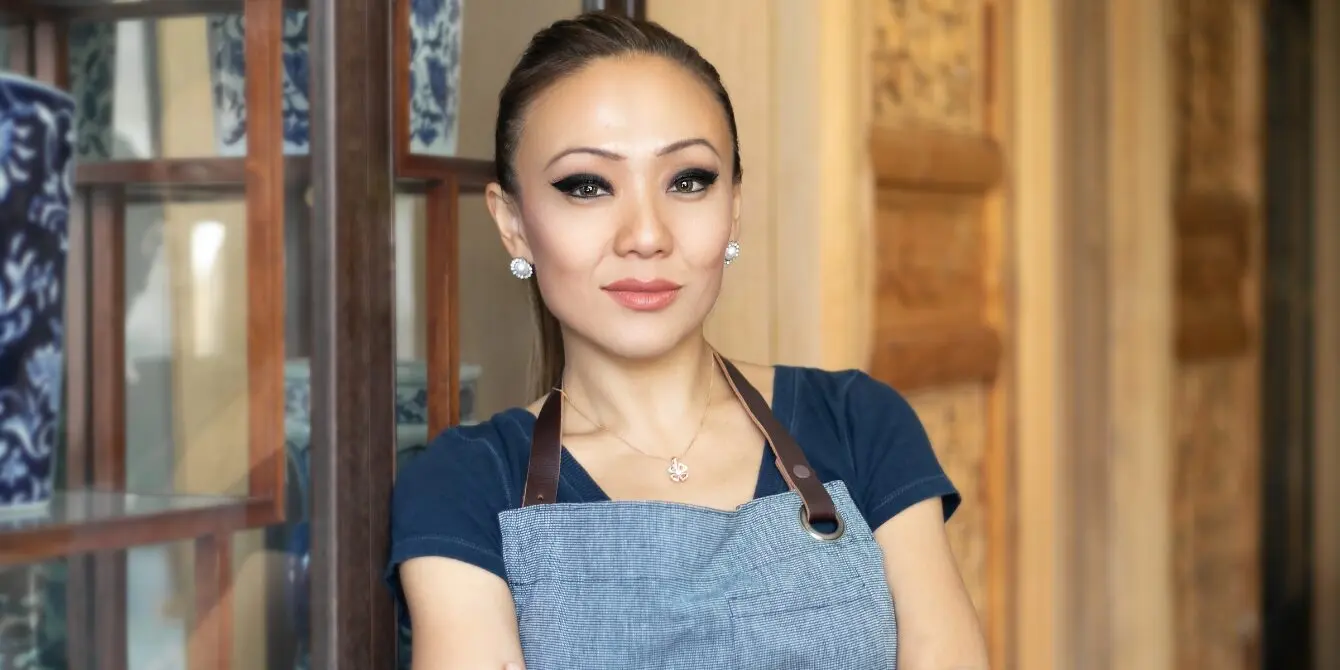
If you caught Food Network’s Chef Dynasty: House of Fang, you already know Chef Kathy Fang doesn’t do anything halfway—not fusion cuisine, not family dynamics, and definitely not the delicate dance of honoring tradition while refusing to be bound by it.
The San Francisco chef grew up spending twelve-hour days at her father’s legendary Chinatown restaurant House of Nanking (because childcare was expensive and the restaurant was home), absorbing everything from her dad’s famous sesame chicken to the unspoken rules of Chinese family culture: work hard, stay humble, never complain.
Fast forward to today, and Kathy’s a two-time Chopped champion, cookbook author, and co-owner of Fang Restaurant, where she’s built her reputation on modernizing Chinese cuisine in ways that sometimes make her traditionalist father wince—and always make diners come back for more. But the real balancing act? Raising her own kids with the work ethic and cultural grounding she inherited while giving them the voice and confidence she had to fight for.
Between running restaurants, competing on TV, and maintaining her non-negotiable Monday-Thursday traditional Chinese dinner schedule (chicken nuggets are strictly weekend territory), Kathy’s figured out that the best recipes—whether for mapo tofu or parenting—come from holding onto what matters while leaving room to innovate.
1. You’re known for modernizing Chinese cuisine while your father represents a more traditional approach. How does that generational tension around food show up in your own parenting? Are there things you’re doing with your kids that would make your parents shake their heads?
I grew up with very traditional Chinese ideals—work hard, never complain, always listen to your elders even if you don’t agree, be humble and don’t call attention to yourself. Very little praise, lots of tough love, respect for authority. Those ideals caused me to lack confidence as a kid to ever speak up. It’s hard to dream big and be a leader when you’re taught to follow and be reserved.
So yes, there’s tension but it’s actually a great thing. I get to choose from both sides. My foundation comes from how I was raised: the work ethic, the humility, the respect. The parts that worked for me, I repeat with my kids. But I’ve added what was missing, room for individuality, self-advocacy, finding your voice.
It’s just like how we create dishes at the restaurant. I can only create successful twists on classics when tradition holds as the foundation. Without it, I’d be creating without the soul of Chinese food. Same with parenting, ’m working with that tension to find the winning recipe. In regard to my parents, they have softened a lot over the years and even more so with my grandkids. I would say it’s the other way around, I’m shaking my head with how my parents are spoiling and letting them do anything they want, a drastic contrast from the ideals they upheld for me. Isn’t it funny how that works?
2. When you’re teaching your kids to cook, how do you balance “this is how we’ve always done it” versus encouraging them to experiment and make things their own?
I’m very much about letting my kids experiment. My daughter is really into cooking right now. I always let her taste first and ask her opinion, what does it need, how does it taste, what could make it better? She gets to think and create.
We start with the basics of what we need to prepare, then she finishes with seasoning. Tasting is such a big part of cooking, the more you taste, the more you develop. Her ideas are not always the best, but that’s why we experiment, we do it to find the right combination of flavors for a winning dish.
Even this morning she asked if she could dip her hard-boiled eggs in whip cream. I told her to try it and let me know how it tastes. I love seeing the thinking behind it, it’s very exciting for me. My son, on the other hand, is not interested in cooking at all haha. With him, I don’t force it upon him. At some point though, I will have to teach him the basics. He has to grow up and be an adult man who can cook and take care of himself.
3. You grew up practically living in your family’s restaurant. Now that you’re a parent running restaurants yourself, how do you think about your kids’ relationship to your work? What parts of restaurant life do you want them to experience?
I actually struggle with this. My parents never had a choice, they had to keep me at the restaurant after school until late at night. They couldn’t afford nannies. When school work started to matter more, they had to get relatives to take turns taking care of me at home so I didn’t have such irregular sleeping hours. We’re now in a much different position. I have help that allows the kids to maintain a normal life and schedule at home.
While this is fantastic for them, I do think about bringing them into my work life more. There were so many lessons learned by being in the restaurant, it taught me to appreciate what we had, I wasn’t spoiled, I learned extreme work ethic, how to talk to people, how to work with numbers and money at a young age. I saw with my own eyes, just how hard it is to make money. My kids don’t have that sense at all because they don’t see it. My kids are lacking that real-life experience.
I’m still trying to figure that part out, how do I expose them to my restaurant life more so they can prepare for what’s ahead. This year we’re bringing the kids to work on Christmas Eve, our busiest day, so we’ll see how that goes.
4. Working with family can be complicated, there’s the business side and the personal side. How has being a parent changed how you navigate those relationships in the kitchen?
Family always comes first. If my father and I have disagreements around work, I always think about how our interaction can impact our relationship. I would never create friction over business. Where there’s a will, there’s a way. I prioritize family first, then business.
Luckily my dad and I think alike, so we don’t have many complicated disagreements. The way I am with my father, is something my employees see. And in a way, we’ve unintentionally created a family like work culture at our restaurant. Our company culture is centered around family. Everyone here putting in their hours are working hard to take care of their own family, so we give our best and we work out kinks together because there are not alternatives.—we treat our kitchen and employees like family, even the way we address them. I call my kitchen crew who are women, Aunties, and they call me little daughter. In American culture it may sound a bit strange but in our culture, it’s a form of respect and closeness if you can use those titles. I would say it’s probably less conventional even in traditional Chinese restaurants but, we’ve never done things the conventional way, just look at House of Nanking and Fang. We have to have our own twist on everything:)
5. For parents trying to pass down their cultural food traditions to kids growing up in America, what’s your best advice? Especially when you’re competing with chicken nuggets and exhaustion?
Consistency. I’ve created a rather strict schedule: traditional Chinese food for dinner Monday-Thursday—one bone broth, one simple Chinese leafy green, one protein that’s steamed, stir-fried, or braised. Everyone knows what to expect.
Growing up in a Chinese immigrant family, I had no say in what I wanted for dinner at home. I would always come home from school to a kitchen already simmering with food for dinner. In a sense there was something really comforting about that. I want to recreate that feeling for my kids. And so dinner, 4 days out of a week is something they don’t need think about and something I don’t have to stress about. My tip is create your top 5-6 dishes, that you rotate through each week, no if ands or buts. Makes everyone’s life easier and the kids are adaptable, they will get use to it, week after week.
As an adult, chef, daughter, and mother, I treasure those Chinese home cooked meals, those memories are so pronounced in my brain. Every dish was made with love and care. That’s what I want to focus on when I cook at home—how do I nurture my kids during their short time under our roof so they have those strong memories they can carry through with them to adulthood. So when they come home after college or after they have their own kids, they ask for those old school dishes they grew up on, that mom would always make. Find those few dishes you love as a mom and make it for your kids often, create that tradition. I’ll tell you one thing, when your adult kids come back, they won’t be asking mom for those Chicken nuggets haha.
To maintain this structure, I allow them to explore Friday-Sunday so they don’t feel deprived of other cuisines—even if that means chicken nuggets and fries is what they ask for on the weekend!
6. What does it look like to raise kids who are comfortable with both their Chinese heritage and their American identity through food? What’s worked for you and what’s been harder than you expected?
I struggled with this as a kid. My father packed “exotic” lunches—pork belly rice, soya chicken with noodles, while everyone else had paper bag sandwiches. I would beg for Lunchables, anything to help me fit in. That feeling of being different, of your food smelling “funny”, I remember it vividly.
My kids have been lucky not to experience that. They’re growing up in San Francisco at a time where Chinese food is on every corner and all the people who live here are so multicultural with advanced palates around various cuisines that my kids showing up with boba to school or talking about XLB isn’t unusual but the norm.
I think if we were to live elsewhere and Chinese food and culture wasn’t as prominent, I would just talk to my kids about their food more. Help them gain greater knowledge around their culture, their cuisine so they can feel confidant about their food being different from others. But even now, I always ask them about everything they eat—if they like it, what they like about it, where it comes from, if any of their friends come from the originating country of the cuisine we are exploring. Find connections through food and people they know so it feels like a bridge to another culture, not a wall.
7. You’ve competed on Chopped, you run restaurants, you write cookbooks – but at home with your own family on a random Tuesday, what does dinner actually look like?
I work evening shifts Monday-Thursday. I pick up the kids from school, bring them home, spend 30 minutes of playtime, then move to homework. Depending on how long that takes, I prep or partially cook dinner for my nanny to finish when the kids are ready. Then I rush off to dinner shift by 6pm.
I get about 2-2.5 hours with them after school. I’ll try to catch them right before bed if I’m lucky and it’s a slower night at the restaurant, which means rushing back around 8:45pm.
8. What are the Chinese dishes or techniques that you think every parent should have in their back pocket? The ones that are actually doable on a weeknight?
Steamed pork patty with eggs! It’s the Chinese version of meatloaf—tender, aromatic pork meatloaf spooned over jasmine rice with over-medium eggs. The ultimate comfort meal, completely foolproof with the right seasoning and amount of cornstarch to tenderize the meat. Takes 15 minutes to prepare and cook, can sit in the steamer for an hour with the fire off and reheats beautifully the next day.
One-pot wonders like Grandma’s chicken curry soup. One pot lasts 2-3 days and you can serve it with noodles, rice, or bread which means 3 meals out of one day of cooking.
Lastly, knowing how to make the perfect fried rice is so clutch, especially if you have a large household. You toss some veggies, eggs and protein of your choice into the pan with rice, and you’ve got another one pot meal. It’s the one thing that almost every Chinese restaurant has to have across the world and that’s because it’s a staple that everyone loves.
9. You’ve talked about how important San Francisco’s food culture was to your childhood. What food memories or traditions are you trying to create for your own kids? What feels important to pass down?
Eating out with my dad during his quick break between shifts. That was our tradition. He worked 7 days a week, double shifts. I never saw him except at the restaurant. After school pickup was my time with him, and we’d try out restaurants all over the city.
It taught me something I didn’t understand until I became a parent myself: it’s not the amount of hours, it’s the quality of time. Busy parents beat themselves up over not being there enough. But finding one non-negotiable block and making it count? That can make all the difference. And of course the way we spent that time over food, helped me foster my love and appreciation for SF food culture.
Because of this, my husband now does daddy-daughter dates once a month where he takes her to dinner somewhere either new or one of her favorite staples. And every weekend, we go out to eat try new restaurant as a family. We explore the various cuisines we have available at our doorstep and show them how beautifully diverse SF is a food is the easiest way to explore that. Our family meals at restaurants is one of my favorite tradition and memory created with my kids currently.
10. Is there a specific dish or meal that you remember from childhood that shaped who you are as a chef and as a parent? What made it stick with you?
The iconic Nanking sesame chicken. This dish put my dad on the map. iIt’s ubiquitous to our brand and the ultimate representation of Chinese American. My father innovated using local ingredients with Chinese techniques, creating something that 38 years later still has a cult following.
I grew up watching its creation, I’ve eaten it more than anything on our menu, and I’ve watched millions of people eat it. It’s ingrained in my brain as the dish that brought our family success. It symbolizes creativity, love, family, and sacrifice.
What makes it even more meaningful now is that my kids love sesame chicken—it’s one of their favorites from our restaurant. The generational reach is so special to me.